Skip to content
Field Notes
FIG.00 · OPERATOR

Mariana Castro

I build tools that turn complex systems into records that are legible, trustworthy and auditable.

I work where systems are hard to inspect. Public services, most recently.

Status: OperationalView Full Résumé

Specification

Discipline
Full-stack
Domain
Legible systems
Core stack
TS · Next · Node · PHP · Python · PG
Base
Ceará / BR
Independent
8 systems
Source
8/8 public
In production
180+ municipalities
Intake
Open · 2026
MC · A RECORD OF BUILT SYSTEMS

§ 01 · Some Things I’ve Built

Flagship · N=04

Independent builds: I chose the problem, designed the system and wrote it, and the source is open for every one.

SYS.01

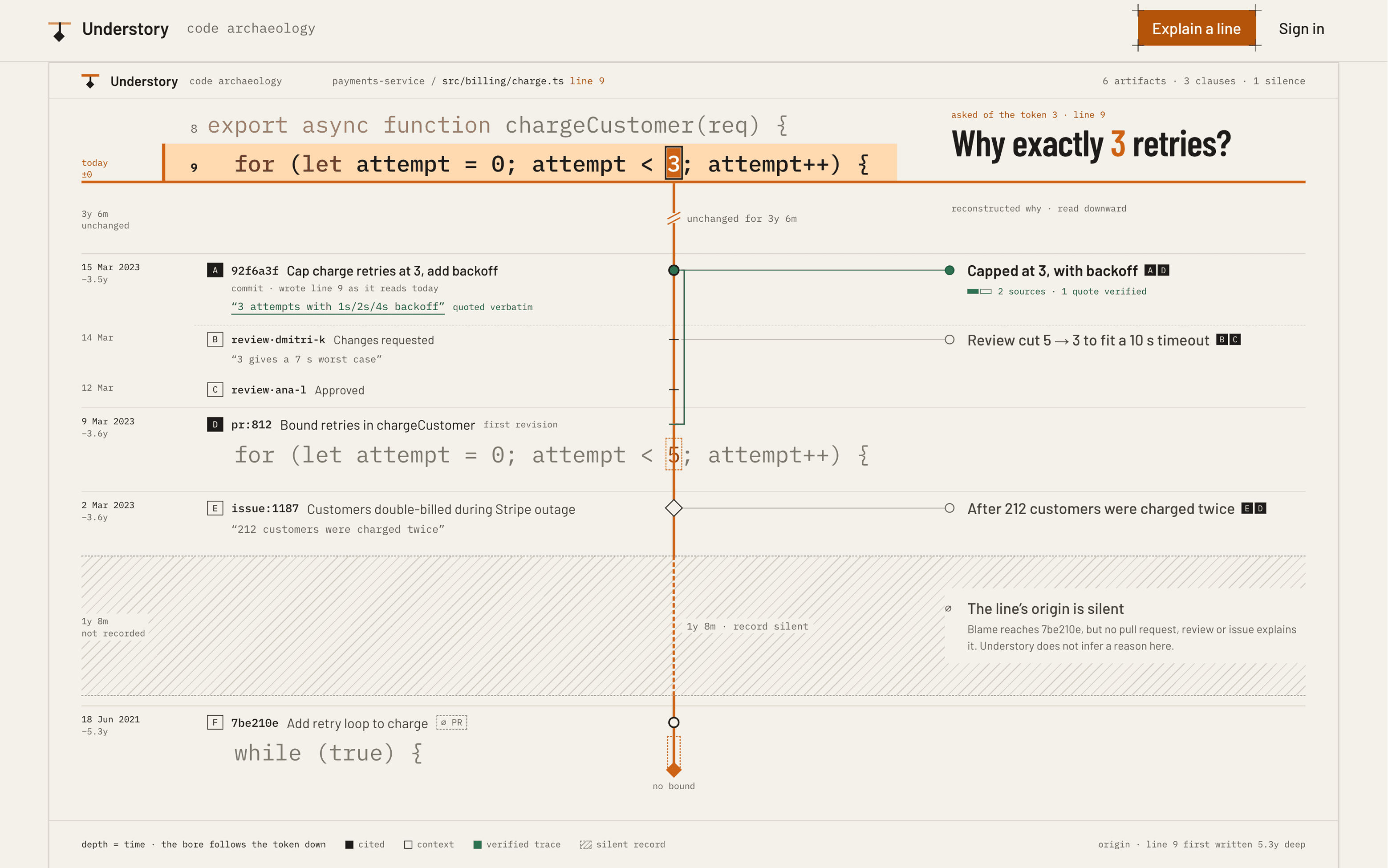
Understory

Explains why a line of code exists, from the commits, pull requests, issues and reviews behind it.

The model only explains evidence collected without it: every citation is checked against the real artifacts, a claim counts as supported only when its source is quoted verbatim, and a silent history is reported as silent.

Evidence

An 8-case gold set runs the real pipeline on a seeded repo: 7/8 pass, out-of-scope questions are refused in 14/14 scored runs, and the failing case is published with its cause.

Full record

Software archaeology for a line of code. Point it at a GitHub or GitLab repository, pick a line, and it follows blame to the commits, pull requests, issues and reviews behind it, then asks a language model to explain the why using only that evidence. The model never has the last word: a deterministic check matches every citation against the artifacts actually collected, a second pass accepts a source as support only when it quotes that source verbatim and the quote is found in it, and confidence is computed from those signals rather than taken from the model. When the history does not explain a line, the case says so and marks the gap. It runs on the web with GitHub sign-in and cases saved to Postgres, from the terminal, as a VS Code extension, or as a Docker container inside a firewalled GitLab.

TypeScriptNext.jsGroqPrisma ORMPostgreSQLDockerVitestPlaywright

SYS.02

Horizonte

A music player where the record has mass, and the mass bends the space around it.

One full-screen fragment shader bends the typography, the cover and the dust using the same gravitational field, with nothing drawn on top.

Evidence

Each record’s physics comes from its own audio descriptors: measured offline in Python, reproduced in the browser by a hand-written FFT held to the same numbers.

Full record

A music player where the record has mass and mass bends space. A single full-screen fragment shader deforms the monumental typography, album art and dust using the same gravitational field, with nothing drawn on top. Collection, album and track exist as one continuous change of scale rather than separate screens. Each record's physics comes from its own audio descriptors, measured offline in Python and reproduced in the browser by a hand-written FFT using the exact same numbers.

Field noteHorizonte: engineering a music player where the record has mass

TypeScriptNext.jsThree.jsGLSLWeb Audio APIWeb WorkersPython & NumPyVitest

SYS.03

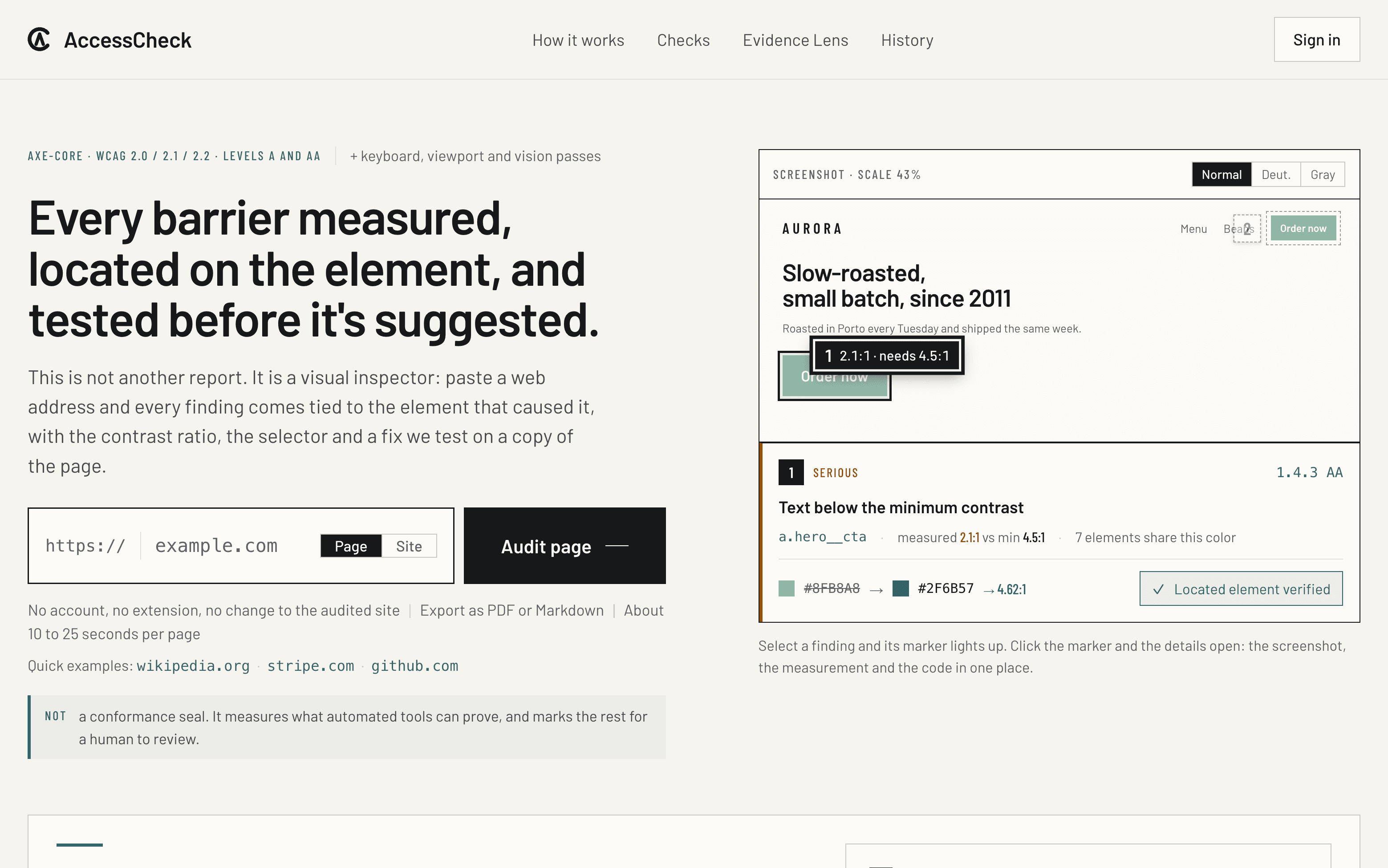
Access Check

Audits any public URL against WCAG 2.2, levels A and AA, and hands back the exact code to paste.

Weighted score, severity-ranked issues, per-element highlighting and colour-blindness / low-vision simulation, exportable as PDF or Markdown. A Chrome extension audits the tab you are already on, even behind a login or on localhost.

Evidence

Fixes that can be applied automatically are tested on a copy of the page and come back labelled verified, failed or unchecked, checked against the DOM, not read off a rule table.

Full record

Full-stack tool that audits public URLs against WCAG 2.0, 2.1 and 2.2, levels A and AA, and provides the exact code needed to fix each issue. Automatic fixes are tested on a copy of the page in a real browser without altering the audited site. It includes a weighted score, severity-ranked issues, affected-element highlighting, the real keyboard focus path, visual simulations, and PDF and Markdown reports. A Chrome extension also audits pages behind a login or running on localhost.

TypeScriptNext.jsTailwind CSSPlaywrightaxe-corePrisma ORMPostgreSQL

SYS.04

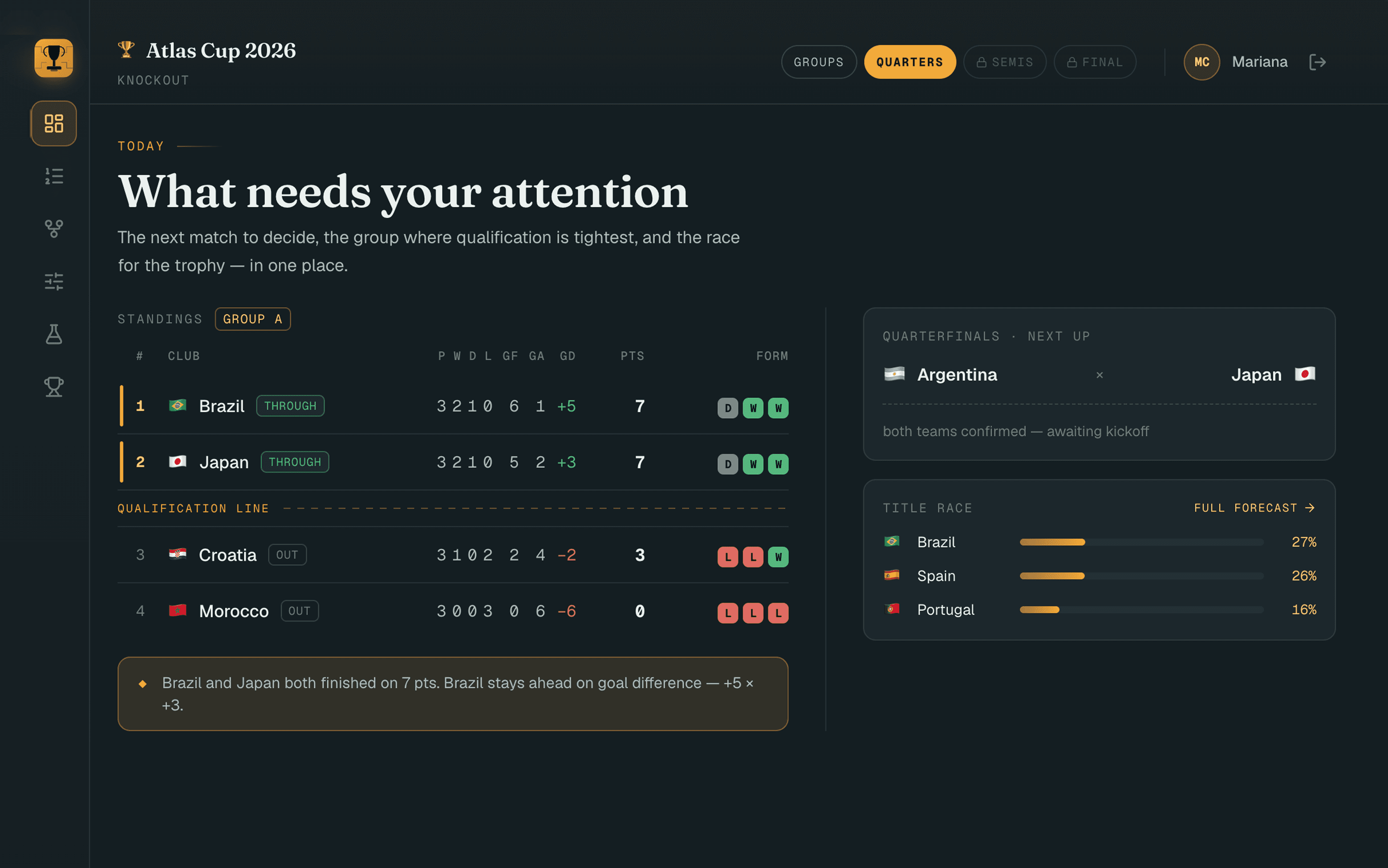
Gauntlet

Tournament engine that turns group and knockout results into a live projection.

Standings and the qualification cut recalculate on every result and stream to any number of spectators over SSE; a what-if mode cascades hypothetical scores into the bracket.

Evidence

Monte Carlo title odds on a TypeScript/PHP standings engine checked against golden test vectors.

Full record

Full-stack tournament engine that turns group and knockout results into a live projection. Standings and the qualification cut are recalculated with every result and streamed to any number of spectators over SSE. Monte Carlo simulations estimate title odds, while a what-if mode cascades hypothetical scores through the bracket. The TypeScript/PHP standings engine is validated against golden test vectors.

TypeScriptNext.jsTailwind CSSVitestPHP & LaravelPostgreSQLPest

§ 01.b · Further Index

Archive · N=04

Plain-language auditor for documents, measured against ABNT NBR ISO 24495‑1.

EvidenceThe fence between proof and signal is a CI step: the build fails if the deterministic core imports the model layer, and 2,500 tests pin each detector to the cases that broke it.

TypeScriptNext.jsTailwind CSSVitestStrykerdependency-cruiserGoogle Gemini

Full record

Deterministic text auditor that checks a document against verifiable criteria for clarity and structure, including those from ABNT NBR ISO 24495-1. Its 23 detectors flag passages that may hinder reading, trace each criterion to its source, and explain why, without altering a word of the text. When a rewrite arrives, from the author or a language model, the engine re-analyses it and separates what it can prove from what it can only signal, with the boundary between the two layers enforced by the build.

Field noteLucid: engineering applied to auditing document clarity

Rebuilds any public web page as an isometric pixel-art city, from the page’s real structure rather than a screenshot.

EvidenceEvery layer is built over a corpus of frozen real pages, switched on and off, and 222 checks fail if it reaches outside itself: polish changes no decision, atmosphere touches only sky and light.

TypeScriptNext.jsThree.jsReact Three FiberZustandTailwind CSSparse5Puppeteer

Full record

Reads the real structure of a public web page and rebuilds it as an isometric pixel-art city you can walk through. The server captures the page and sends the client only structure and metrics, never HTML; the client turns each part of the page (hero, navigation, feed, index, references, footer) into a district whose land follows how much of the page it occupies and whose buildings follow what it holds, so a news front page, a documentation site and a shop produce recognisably different cities. Click any building to see the excerpt of the page it came from, or ask the city why it looks the way it does. Fetching arbitrary URLs is the riskiest thing it does, so SSRF is closed at the socket, with every redirect validated again, and real images come through an HMAC-signed proxy; sites behind a bot challenge or a login are refused, never worked around.

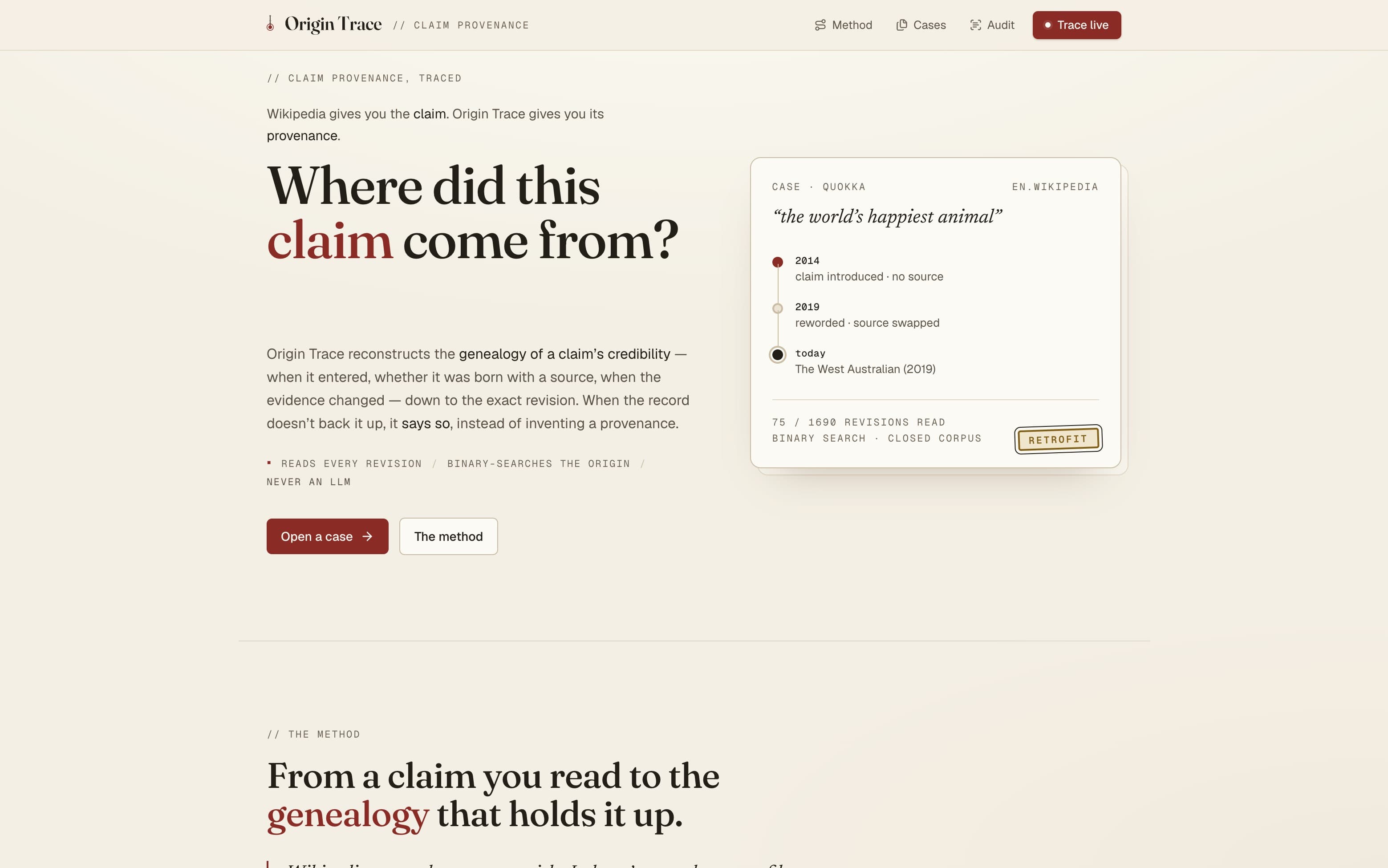
Finds the exact Wikipedia edit that introduced a sentence and determines whether it ever had a source.

Evidence278 tests drive a fake Wikipedia instead of the live API; one caps a full descent at 20 revision reads, so the O(log n) claim breaks the build if it ever regresses.

Next.jsTailwind CSSTypeScriptVitest

Full record

Provenance tracer for any Wikipedia claim: with no AI and no guessing, it bisects a revision history thousands of entries long to find the exact edit that introduced a sentence — reading dozens of revisions instead of all of them — then classifies whether the claim was born with a source, had one retrofitted later, or never had one. It follows the sentence through rewordings by shared anchors, flags circular sourcing, and audits a whole article sentence by sentence into an evidence-health dossier.

Field noteThe cache that never hit once

A full reading platform built as a single Next.js app: library, feed, submissions and moderation.

Evidence400 seeded leave-one-out trials: hit-rate@4 ≈ 0.845 against 0.15 for random, and the test fails below 0.8.

TypeScriptNext.jsTailwind CSSJestPrisma ORMPostgreSQLNextAuth.Js

Full record

Full-stack reading platform — library, feed, ratings, submissions and a moderation workflow, behind Google, GitHub and credentials auth. The recommendation rail is the part taken seriously: a pure, dependency-free module that blends a Bayesian-damped community rating with category affinity, tells the reader why each book was picked, and — holding no database — can be evaluated offline. A seeded leave-one-out harness hides a book each synthetic reader would love among distractors and reports hit-rate@4 ≈ 0.845 and MRR ≈ 0.766 over 400 trials, against a random baseline of ~0.15. The test fails below 0.8, so the number stays measured rather than remembered.

§ 02 · Professional Experience

Field Record · N=04

Systems running in production inside public institutions, with real users, real scale and continuity after I shipped them.

Apr 2025 – Present

Tech Lead & Full-Stack Developer

Computer Engineering and Systems Laboratory, Federal University of Ceará
Research grant · coordination

Technical lead of the ERP that took LESC’s project management as an EMBRAPII unit off spreadsheets, leading ten people across DevOps, front end, back end and QA while also writing front-end code.

  • Proposed moving the front end from Flutter to React and Next.js, which the team adopted: native HTML, DOM and CSS, easier accessibility work and direct browser APIs, and mature libraries for the forms and tables an administrative system runs on.
  • Introduced front-end testing with Vitest and Testing Library on jsdom, so components and interface behaviour are tested without running the whole application in a browser.
  • Set the team’s working conventions: Conventional Commits, a Trello template stating the minimum a task needs before it reaches development, and a link from every card to its pull request, so any request leads straight to its implementation.
  • Onboarded all four people who joined in recent months, from the project’s context and architecture to the team’s standards and workflow, staying with each until they could work more independently.
  • Built the financial simulation module for project prospecting, with an approval workflow and persisted results.
  • Moved activity reporting, review and signing into the ERP, DocuSeal replacing DocuSign since May 2026, retiring emailed PDFs and hand-set signatures that slowed payments and left reported work untraceable.

PythonFlaskNext.jsReactTypeScriptPostgreSQLVitestDocuSeal

FIG · ERP LESC
Mar 2025 – Present

Full-stack delivery for the state government’s innovation lab, from citizen-facing applications to the internal automation the teams run on.

  • Technical lead and developer of a plain-language auditor for public documents, in a two-person team: database modelling, every screen and every feature, plus an evaluation section where colleagues rate the quality of each simplification. In internal use while still in development.
  • Still building the Ceará Sem Fome platform, which began under the Chief Scientist programme in partnership with ÍRIS and is maintained here today by a smaller team, where I am one of its two developers, with two more people on deployment.
  • In a team of three developers, designed the levels, dialogue and every scene of CNH Popular, mini-games included: a pixel-art game that walks citizens through each step of the state’s subsidized driver’s-licence programme.
  • Orchestrated the political-articulation team’s invitation dispatch end to end in n8n, against the official WhatsApp API via Zion, replacing a manual send of 200 to 500 invitations made at least twice a week.

Shipped at ÍRIS

CNH Popular visits
3,000+
invitations per run, 2× a week
200–500

Next.jsTypeScriptTailwind CSSPHP & LaravelMastra AIStyled ComponentsPostgreSQL

FIG · CNH POPULAR
Aug 2023 – Mar 2025
Continues at ÍRIS

Full-stack development of the web and mobile platform for Ceará Sem Fome, a state programme for food security and professional training for socially vulnerable populations.

  • Technical lead from November 2024 to March 2025, leading five developers, two QA engineers and two people on deployment.
  • Created the unified design system shared by the web and mobile products.
  • Built the CRUD for the programme’s kitchens, managing units and beneficiaries. The platform is where they are registered, not a reporting layer over another system.
  • Delivered the analytics dashboards used for monitoring and data-driven decisions.

Registered and reported through the platform

kitchens
1,200+
municipalities
180+
meals per day
130k+
enrolled in courses
20,000+

Paper · double-blind review

Uma Plataforma Digital para Visualizar Dados e Indicadores do Programa Ceará sem Fome

XII WCGE 2024 · Brazilian Computer Society · pp. 111–120 · in Portuguese · co-author, 3rd of 7

React.jsMantine UITailwind CSSPHPLaravelPostgreSQL

FIG · CEARÁ SEM FOME
Mar 2023 – Aug 2023

Built the web and mobile interfaces for IoT-based monitoring of emergency medical devices.

  • Real-time tracking and status management for defibrillators and cardioverters.
  • State accuracy was the hard requirement: a wrong reading of availability, location or operating condition sends a team to the wrong place, double-books a device, or delays an emergency call.

Next.jsReact.jsReact NativeTailwind CSSExpo

FIG · IN.TRACK

§ 03 · Open Source Contributions

Upstream · N=18

Upstream fixes: someone else’s codebase, conventions and review. Each patch traces a reported problem to its cause, ships with a test that fails without it, and was merged by the project’s maintainers.

Projects · 09Carbon Design System (8 patches)axe-core (2 patches)Zag (2 patches)SvelteTypeScriptNuxt ContentMaterial UIBase UIReact Spectrum

Merged upstream · 2418 documented belowAll on GitHub

PATCH.18

IBM Carbon Design System

carbon-design-system/carbonPR #23821 Merged ·

fix(MultiSelect): keep highlight and selection in sync with custom sortItems

Problem
With a custom sortItems, MultiSelect highlighted one option and selected another.
Fix
The sorted list is computed once and shared by Downshift and the menu.

Areas: AccessibilityFormsReact

Investigation
Conditions
Reproduced on @carbon/react 1.119 and on main, with a sortItems that returns a new array instead of sorting the one it receives, which the documented signature allows ([...items].sort(), toSorted(), lodash sortBy). With Alpha, Bravo and Charlie sorted descending, ArrowDown highlighted Charlie on screen, aria-activedescendant sent screen readers to Alpha, and Enter selected Alpha.
Cause
The issue was filed with this diagnosis. useSelect received items: filteredItems in the original order, while the menu rendered sortItems(filteredItems, sortOptions) and set isHighlighted from the index in that sorted list. Downshift’s highlightedIndex, the option ids from getItemProps and the Enter selection all used the index in filteredItems. The two orders only lined up because defaultSortItems calls items.sort(), which sorts that same array in place.
Change
The sorted list is now computed once with useMemo and passed to both useSelect and the rendered menu, the approach FilterableMultiSelect already takes. The ItemClick lookup for setHighlightedIndex in the state reducer uses the same list. The selectionFeedback handling (top, fixed, top-after-reopen) is unchanged, only moved into the memoized sort, and the default sort behaves as before.
Test
One test renders the three options with a descending sortItems that returns a new array and checks, after each ArrowDown, that the option highlighted on screen is the one in aria-activedescendant, and that Enter selects that same option. Without the change it fails at the first aria-activedescendant, which points to Alpha while Charlie is highlighted: the reported case.
Decision
The selected-on-top input was rewritten at a maintainer’s suggestion, as an object keyed by selectionFeedback instead of the if/else, to match FilterableMultiSelect; the fix itself did not change. The issue and the PR opened in the same minute, ten minutes after #23819 on the same component; two maintainers approved it.
Issue#23820Merged by@kennylam
PATCH.17

IBM Carbon Design System

carbon-design-system/carbonPR #23819 Merged ·

fix(MultiSelect): omit empty aria-activedescendant on the toggle button

Problem
MultiSelect put an empty aria-activedescendant on its combobox button.
Fix
Downshift’s empty value is now omitted until an option is highlighted.

Areas: AccessibilityDOMReact

Investigation
Conditions
Reported on @carbon/react 1.115 with React 18, from the IBM Equal Access Accessibility Checker, which flagged a 4.1.2 Name, Role, Value violation: the role="combobox" toggle button rendered aria-activedescendant="" as soon as the component mounted, and again when the menu opened with no option highlighted.
Cause
The report had the symptom, a reproduction and the checker’s result. The value came from Downshift 9.4: useSelect’s getToggleButtonProps returns the highlighted option’s id only while the menu is open and an index is highlighted, and '' otherwise, not undefined. React writes an empty string to the DOM, so the combobox pointed at no element whenever nothing was highlighted: closed, or opened by a click with no selection.
Change
The props from Downshift are kept under a new name, and the toggle button gets a copy whose aria-activedescendant turns an empty value into undefined, so React leaves the attribute out. With an option highlighted it still points to that option’s id, and every other prop passes through, so keyboard navigation is unchanged.
Test
One test walks the combobox through its states: no attribute on mount, none after a click opens the menu with nothing highlighted, the first and then the second option’s id after two ArrowDown presses, and none again after Escape closes it. Without the change it fails at the first assertion, the reported case.
Decision
Dropdown gets the same empty value through useSelect, and ComboBox and FilterableMultiSelect through useCombobox; the PR names all three and leaves them out, to keep it to the reported component. It opened about two hours after the issue, two maintainers approved it, and it merged as opened.
Issue#23815Merged by@heloiselui
PATCH.16

IBM Carbon Design System

carbon-design-system/carbonPR #23666 Merged ·

fix(styles): remove global menu overflow rule from page header

Problem
Nested menus opened inside their parent, clipped, with a horizontal scrollbar.
Fix
Removes a page header rule that turned every open .cds--menu into a scroller.

Areas: SassCSSFocus management

Investigation
Conditions
Filed by a Carbon maintainer as a Severity 2 regression in the v12 OverflowMenu Nested story with autoAlign, marked as needing investigation; the report wondered whether nested menus needed Floating UI’s FloatingTree. The rule had already shipped in v11.118.0-rc.0, so ComboButton and every submenu positioned by MenuItem were affected on any page loading @carbon/styles.
Cause
The cause was in another package. _page-header-next.scss, added in #23209, set max-block-size and overflow-y: auto on every open .cds--menu, and that rule beat .cds--menu--shown { overflow: visible } from #18462. Submenus are position: fixed descendants of their parent menu; when the parent has a transform, as floating styles give it, it becomes their containing block, so they were clipped inside it. #17781 and #18320 had reported the same failure, which #18462 fixed.
Change
The 12 lines go and nothing replaces them. In ibm-products, where the page header came from, the same rule was scoped under .c4p--page-header__next, so it never matched the portaled MenuButton menu; in Carbon it had lost that scope. Removing it restores the behavior from before #23209, in v11 and v12 alike.
Test
No new test: the change only removes CSS, and the existing packages/styles tests pass. The PR gives a Storybook check instead: the v12 Nested story through four levels, by hover and by ArrowRight, again with autoAlign, the v11 feature-flag story, and MenuButton with a nested menu.
Decision
The rule is removed rather than overridden with a more specific selector, which would have left a page header component styling every menu on the page. The FloatingTree restructure the report had considered was not needed. The PR opened less than four hours after the issue; the maintainer who filed it approved within the hour, two more approved later, and it merged as opened.
Issue#23660Merged by@devadula-nandan
Earlier patches · 15
PATCH.15

Adobe React Spectrum

adobe/react-spectrumPR #10766 Merged · Co-authored · PR by @UditDewan

fix: report every user caret move through TokenField onChange

Problem
A TokenField reported only every second caret move through onChange.
Fix
The programmatic-selection flag is now set only when the selection changes.

Areas: DOMFormsReact

Investigation
Conditions
Found on main while writing browser tests for TokenField caret handling, and reproduced in Chromium, Firefox and WebKit: in a field holding abcdefgh, Home and six ArrowRight presses moved the DOM caret to 1 through 6, while onChange reported only 2, 4 and 6. ArrowLeft, Shift+arrows and clicks behaved the same; typing and deleting did not.
Cause
The issue was filed with this diagnosis, before either pull request. setTokenFieldSelection set root[isProgrammaticSelectionChange] before its “only set selection if it has changed” check. After a user caret move, the layout effect called it with the position the browser already had, setBaseAndExtent was skipped, and no selectionchange came to consume the flag, so useSelectionChange discarded the next real one. The guard came from #10438, which also began storing the range on every caret move.
Change
The flag assignment moves inside the if, so it is set only when setBaseAndExtent actually runs; when the selection is already in place, nothing is marked and the next user move goes through. The issue proposed this one-line change and #10765 made it; the merged pull request applies the same line.
Test
The merged test is the other author’s and replays the issue’s sequence: abcdefgh, Home, six ArrowRight presses, onChange reporting 1 through 6. The test from #10765 also crossed tokens, moved left and checked the DOM selection at each step; it was reverted because its ArrowLeft step across a token fails in WebKit on CI, the separate bug the issue had set aside.
Decision
The two pull requests carried the same fix, opened half an hour apart, and the maintainer asked their authors to compare them. #10765 was closed in favor of #10766, which took its test with co-author credit. Before review, that test was flagged as failing in WebKit on CI, an earlier claim that it passed in all three engines was corrected, and dropping it kept the pull request focused. Shift+ArrowLeft across tokens in WebKit stays out, as a separate bug.
Issue#10764Own PR#10765Merged by@snowystinger
PATCH.14

MUI Base UI

mui/base-uiPR #5966 Merged ·

[menu] Keep the filter query until the popup finishes closing

Problem
With external filtering, a Menu showed its full list while animating closed.
Fix
The query is now cleared once the popup unmounts, not when it starts closing.

Areas: Component lifecycleReactFramework internals

Investigation
Conditions
@base-ui/react 1.9.0: a filterable Menu with filter={null}, its items filtered by the consumer from the controlled value. After typing a query and closing with Escape, an item press or an outside press, the input kept the text through the exit animation while the list jumped back to every item, in root menus and submenus alike.
Cause
The report had the symptom and a reproduction. useFilterDropdownCloseQuery cleared the query in the commit that closed the popup and kept a private copy for the exit, read only by the built-in filter and Menu.Input. Anything derived from value saw an empty query while the popup was still on screen, including, with built-in filtering, a Create "{query}" item the report had not covered.
Change
The hook now marks the reset as pending on close and settles it, through the same onValueChange call, once the popup unmounts: the lifetime Combobox already gives an input inside its popup. A reopen mid-exit settles it too, and so does a filter root that unmounts first. Canceling the change still keeps the query, and the shared hook carries the fix to the filterable Select in progress.
Test
Seven tests, most in Chromium with the exit animation running: filtered items stay through the exit in root menus and submenus, after Escape, an item press and an outside press; a derived item stays; a reopen mid-exit resets once; a close that prevented unmounting waits for actionsRef.unmount(); and both unmount-first cases still reset. Five fail without the fix; the other two guard existing paths.
Decision
The reset now reaches consumers after onOpenChangeComplete(false) instead of at close, and the PR stated it as a behavior change. The maintainer’s review found that the first version, which reset only on seeing the popup unmount, lost the reset when the filter root unmounted first, and asked for it to be settled from an unmount cleanup. Both cases reproduced and each got a test. The maintainer restored the docs wording and merged.
Issue#5965Merged by@atomiks
PATCH.13

IBM Carbon Design System

carbon-design-system/carbonPR #23579 Merged ·

fix(Tag): apply tabIndex to the truncated label tooltip trigger

Problem
A truncated Tag with tabIndex={-1} still took focus through its tooltip.
Fix
The tooltip trigger now takes the tag’s tabIndex when the label truncates.

Areas: AccessibilityFocus managementReact

Investigation
Conditions
Reported by the IBM Knowledge Catalog team on @carbon/react 1.117 with React 19, the same day as the ExpandableSearch report: two tags in a narrow container, the second given tabIndex={-1}. Its label was long enough to truncate, and Tab still stopped on it.
Cause
The report had the symptom and a reproduction. When a label truncates, Tag wraps it in a DefinitionTooltip, which renders its own <button> as the trigger, and that button is the element that takes focus. tabIndex was not a Tag prop: it fell into the rest props and landed on the outer element, so -1 left the trigger in the tab order, and 0 or a positive value made the outer element focusable as well, two tab stops for one tag. The report had seen only the first case.
Change
tabIndex becomes a documented Tag prop. When the label truncates and the tag is not interactive, it goes to the DefinitionTooltip, which already spreads its remaining props onto the trigger button, and the outer element gets none; otherwise it stays on the tag, so a short label behaves as before. OperationalTag, SelectableTag and DismissibleTag render no DefinitionTooltip, and the first two already put tabIndex on their button, so they were left unchanged.
Test
Five tests, with truncation forced by mocking scrollWidth: a short tag keeps the attribute on its own element; a truncated tag moves it to the trigger and off the wrapper; with -1, Tab skips the tag and lands on the next button; with 0, Tab stops once; OperationalTag keeps tabIndex on its button. Three of them fail without the change. The public API snapshot records the new prop.
Decision
The prop follows focus rather than the DOM: on the trigger when there is one, on the tag otherwise, as Carbon’s v12 OverflowMenu already does with its trigger button. In review a maintainer asked for the prop’s doc to say that only some truncated tags render the tooltip, and it was rewritten by hand so the propTypes comment stayed in sync. Two maintainers approved it and the code merged unchanged.
Issue#23577Merged by@kennylam
PATCH.12

Material UI

mui/material-uiPR #49269 Merged ·

[tabs] Fix indicator position and size when an ancestor is scaled

Problem
Inside a scaled ancestor, the Tabs indicator had the wrong position and width.
Fix
Measures the scroller’s scale once and divides it out of every rect it reads.

Areas: GeometryCSSReact

Investigation
Conditions
Any Tabs with a CSS transform: scale on an ancestor: a zoomable canvas, a scale-to-fit dashboard, or the docs demos with transform: scale(1.2) on a parent box. The indicator sat off the selected tab and at the wrong width, and scrollable tabs scrolled the selected one to the wrong place. Reported in 2022 and answered as a styling question, the issue was reopened as a bug on 30/09/2026, after a user showed it under a canvas zoom.
Cause
The issue had the symptom and a sandbox. updateIndicatorState subtracted two getBoundingClientRect() values, which are viewport pixels and already include the ancestor’s scale, added scrollLeft, which is in the scroller’s own pixels, and wrote the result as the indicator’s left and width. The indicator lives in the same scaled subtree, so the browser applied the scale a second time: under scale(2), a 120px tab 120px from the start got an indicator 240px wide at 240px, drawn at 480. The diagnosis was posted on the issue the day it reopened.
Change
getTabsMeta measures the scroller’s scale on the main axis (width / offsetWidth, or height / offsetHeight when vertical) and returns it with the rect. The indicator divides the rect delta and the tab size by it before adding the scroll offset; scrollSelectedIntoView converts the scroll-padding into viewport pixels and the scroll delta back. offsetWidth is a whole number, so a 300.5px scroller would read as a scale of 1.0017: a difference under a pixel counts as no scale, and untransformed layouts keep their sub-pixel values exactly.
Test
Four browser tests: horizontal tabs under scale(2), vertical tabs under scaleY(0.5) and scrolling the selected tab into view under scale(0.5), all three failing on master, plus a fractional 300.5px layout with no transform that pins the indicator to the tab’s rect within 0.001px, so the fallback cannot round sub-pixel precision away.
Decision
In review the maintainer asked for the scroll into view to be covered as well, for vertical scaling with scaleY, for the isFinite and negative-scale checks to go, and for browser tests only; the two JSDOM tests were removed. One guard stayed, with its reason: under transform: scale(0), the first frame of Zoom, the rendered size is 0 and the division would turn the indicator into NaN, and 12 existing tests mock getBoundingClientRect without a width. The maintainer removed two lines from the tests; the code merged as written and was cherry-picked to v9.x (#49461).
Issue#35631Merged by@ZeeshanTamboli
PATCH.11

IBM Carbon Design System

carbon-design-system/carbonPR #23544 Merged ·

feat(react): add translateWithId to TextInput and TextArea

Problem
TextInput and TextArea announced their character counter in fixed English.
Fix
Adds translateWithId: one ID per message, with the counts as arguments.

Areas: AccessibilityInternationalizationReact

Investigation
Conditions
@carbon/react 1.117 in any product that is not in English: a TextInput or TextArea with enableCounter and maxCount. With ten or fewer characters or words left, and again at the limit, a role="alert" region announces 5 characters left. or Maximum characters reached. whatever the page’s language. The team that reported it translates every string of its product through message catalogues and had recorded the two announcements as known accessibility exceptions.
Cause
The report had located two templates: getAnnouncement built N characters left. and Maximum characters reached. from entity names its callers passed in, and no prop reached it. Reading both callers turned up a third fixed string, one the report did not list: with the counter on, TextArea rendered a visually hidden Character limit N or Word limit N and pointed the textarea’s aria-describedby at it.
Change
Adds translateWithId to TextInput, TextArea and their fluid variants, following the translation pattern in Carbon’s docs/style.md: two IDs for TextInput and six for TextArea (remaining, maximum reached and limit, each for characters and for words). getAnnouncement now receives the IDs and the translator instead of entity names, and returns null under the same conditions as before. Without the prop, every English string is unchanged. Both components’ docs gained a table of the IDs, their defaults and their arguments.
Test
Component tests pin the default English announcements and their translated counterparts, in character and in word mode, plus the translated TextArea description and the count and maxCount each ID receives; the translated cases fail without the change. Two more guard the edges: the prop never lands on the <input> or <textarea> as a DOM attribute, and a translator written inline, a new function on every render, does not restart the delay before an announcement. getAnnouncement has its own tests for the thresholds, and the public API snapshot records the new prop.
Decision
One ID per message, receiving { count, maxCount }, instead of separate singular and plural IDs. Languages disagree on which numbers take a plural, the problem an older Carbon issue (#4720) documents for 0 item selected, so the choice of form is left to the consumer’s i18n tool, as docs/style.md asks of messages that depend on a count. FluidTextInput passes the prop to TextInput only: PasswordInput has no counter announcement and would have spread it onto the <input>. The web components were left out after checking that cds-text-input and cds-textarea do not render these announcements. Two maintainers approved it and it merged as opened.
Issue#23535Merged by@annawen1
PATCH.10

Zag

chakra-ui/zagPR #3405 Merged ·

fix(checkbox): sync hidden input when initially indeterminate

Problem
A checkbox that started indeterminate exposed a plain unchecked native input.
Fix
The machine now syncs the native input on entry, as select already does.

Areas: AccessibilityState machinesForms

Investigation
Conditions
@zag-js/checkbox 1.45.0 with defaultChecked: "indeterminate" or a controlled checked: "indeterminate", in every framework adapter. The control showed the mixed state while the hidden input kept indeterminate: false until the first change, so a screen reader on that input announced “not checked” instead of “mixed”, :indeterminate did not match, and the same held after a form reset with no interaction yet. Reported by someone testing through Ark UI, which is built on Zag.
Cause
The machine wrote the native input in one place, syncInputElement, called from a watch on checked. track skips the initial value in every adapter, so the action never ran on mount, and indeterminate has no HTML attribute, so the render could not set it either: the machine state said "indeterminate" and the input said nothing. The report showed the mismatch; why it happened was not in it.
Change
Adds entry: ["syncInputElement"] to the checkbox machine, two lines, so the action that already kept the input in step with later changes also runs once on mount. That write sets the values the input already has, apart from indeterminate, and dispatches no events.
Test
An indeterminate example page in five frameworks (Next, Nuxt, Preact, Solid and Svelte) mounts an uncontrolled and a controlled checkbox; a Playwright test opens it and checks that the hidden input’s indeterminate is true and checked is false before any interaction. It fails without the change.
Decision
Syncing on entry follows the precedent select set with syncSelectElement, so the input is still written by one action rather than a second, per-adapter mount effect. The first commit also tested the controlled case, a click clearing the state, a form reset restoring it and an accessibility pass; in review the maintainer trimmed the e2e to the initial case, the one that fails without the fix, and reworded the changeset. The fix and the five example pages are from the first commit.
Issue#3402Merged by@segunadebayo
PATCH.09

IBM Carbon Design System

carbon-design-system/carbonPR #23580 Merged ·

fix(Search): apply tabIndex to the collapsed expandable search button

Problem
A collapsed ExpandableSearch stayed in the tab order even with tabIndex={-1}.
Fix
While collapsed, the expand button now takes the consumer’s tabIndex.

Areas: AccessibilityFocus managementReact

Investigation
Conditions
Reported by the IBM Knowledge Catalog team on @carbon/react 1.117 with React 19: an ExpandableSearch given tabIndex={-1} to keep it off the keyboard path. While the search was collapsed, Tab still stopped on its magnifier; once expanded, the input honored the prop.
Cause
ExpandableSearch passes tabIndex through to Search, which applies it to the <input> only. While the search is collapsed, that input is inert with tabIndex="-1", and the one focusable element is the magnifier, a role="button" whose tabIndex was hard-coded to 0, so the prop went to the one element that could not take focus. The report had pinned the symptom to the collapsed button.
Change
One expression in Search.tsx: while collapsed and enabled, the expand button takes tabIndex ?? 0 instead of 0. The other states keep their values: no tabIndex when disabled, and -1 once expanded, where the prop keeps going to the input. A search without tabIndex behaves exactly as before.
Test
Four tests across Search and ExpandableSearch: the collapsed button carries -1, a disabled button carries no tabIndex even when one is passed, and after expanding by click the input carries the prop. The collapsed-button tests fail without the change.
Decision
Disabled takes precedence over the consumer: a disabled button gets no tabIndex even when one is passed, so tabIndex={0} cannot put a disabled control back in the tab order, and a test pins that case. The PR merged as opened, with no change in review.
Issue#23578Merged by@heloiselui
PATCH.08

axe-core

dequelabs/axe-corePR #5406 Merged ·

perf(target-size): skip neighbors at least minOffset away before checking role

Problem
target-offset measured every neighbor in a 200px grid, even ones too far away.
Fix
An opt-in findNearbyElms margin drops far neighbors before any expensive work.

Areas: PerformanceAccessibilityGeometry

Investigation
Conditions
Any audit that runs the target-size rule (WCAG 2.5.8), which is off by default and enabled explicitly. The cost grows with how densely targets sit: on the repository’s MDN page, one run checked the role of 213,510 neighbors and called getOffset 33,279 times.
Cause
findNearbyElms(vNode, minOffset) returns every element in the 200px grid cells around the target, and target-offset ran getRoleType, isFocusable and getOffset on each of them, including neighbors far enough away that they could never be “too close”. The issue, opened by the maintainer, asked to test target-size performance and fix what turned up; this was the waste it turned up.
Change
Adds an opt-in withinMargin option to findNearbyElms that returns only elements whose bounding box overlaps the target’s box grown by the margin, skipping the rest before the dedupe and isFixedPosition; target-offset opts in with minOffset. No offset result can change: a skipped neighbor is at least minOffset away box to box, so its offset is at least minOffset / 2 and the doubled value never falls below minOffset. The one difference is deliberate: a far neighbor with too many rects used to leave the target incomplete, and it is now skipped, which is right because it cannot be too close.
Test
Six findNearbyElms tests pin the margin (same grid cell, exactly at the margin, diagonals, margin: 0) and five target-offset tests pin the distances that matter, such as an undersized neighbor 21px away that must still fail. Breaking the filter in eight ways (half the margin, a hard-coded 24, summed axes, an inclusive boundary…) made at least one test fail each time. On 5,515 nodes across the repository’s perf pages and five synthetic pages, results were identical; getOffset calls fell by 65 to 94% and the rule took 14 to 45% less time.
Decision
The first version filtered inside target-offset. In review the maintainer suggested moving the filter into findNearbyElms so other callers could use it, as an option so the public API would not break; that version also ran 2 to 5% faster. target-size stays out on purpose: it reads the same list to find content that overflows the target, and opting it in turned 186 of 300 incomplete results into violations on a test page. The maintainer reran it on separate benchmark sites and confirmed both the speedup and the unchanged results.
Issue#5389Merged by@straker
PATCH.07

Nuxt Content

nuxt/contentPR #3861 Merged ·

fix(search): preserve word boundaries between block elements

Problem
Search glued table cells together, so a cell’s first word never matched.
Fix
Text extraction adds one space between blocks and none inside inline text.

Areas: SearchMarkdownParsing

Investigation
Conditions
useSearchCollection and queryCollectionSearchSections on any page whose text sits in sibling block elements: table cells and rows, list items, paragraphs in a blockquote, the blocks inside an MDC component. The report’s table was indexed as Setting NameDescriptionapi_keyYour API…, so searching for Description, Your or Request missed the section.
Cause
The report traced it to extractTextFromAst, which joined child text with an empty string. What it left open was why nothing separated the blocks: the @nuxtjs/mdc compiler drops the newline-only text nodes between block siblings, so the tree’s structure was the only record of a boundary, and the glue reached every block structure, not only tables.
Change
Rewrites extractTextFromAst as one walk that marks a pending boundary on entering and leaving a block element and writes a single space before the next text only when neither side already has whitespace. Inline elements set no boundary, and the boundary is a flag rather than a count, so nested blocks never double the space; existing whitespace is left as it was.
Test
Ten unit tests pin the boundaries in tables, minimark bodies, nested and loose lists, blockquotes, MDC components and slots, around <br>, <hr> and ignored blocks, and pin that inline text and headings come out exactly as before. An end-to-end test parses the report’s table with the real MDC parser, indexes it into an in-memory SQLite FTS5 table and searches each cell’s first word; the old extractor fails it.
Decision
Joining children with a space would have fixed the tables and broken inline text: un**bold**ed would index as un bold ed, so the boundary follows the tree instead. The PR treated unknown and custom tags as inline; in review the maintainer inverted that rule, listing the inline tags so that everything else, raw HTML blocks such as <article> and custom components included, separates (an automated review had flagged article and figure). The maintainer also made an ignored block set its own boundary next to bare text and added img as inline. The walk, the single-space rule and the tests, one expectation aside, are from the first commit.
Issue#3860Merged by@farnabaz
PATCH.06

TypeScript

microsoft/TypeScriptPR #64460 Merged ·

Fix declaration maps for export assignment expressions

Problem
TS 7 emitted no .d.ts.map mappings for export default of an expression.
Fix
Synthesized export assignments now keep the statement’s source-map range.

Areas: CompilerSource mapsGo

Investigation
Conditions
The native compiler (TypeScript 7) with declaration and declarationMap on, and an export default or export = of anything other than an identifier, such as export default { b, d }. The .d.ts was byte-identical to TypeScript 6.0’s, but its map came back with "mappings":"", so no position in it resolved to the source.
Cause
For these cases declaration emit synthesizes a declare const _default and a new export default _default;. When that logic moved into a shared transformExportAssignment (microsoft/typescript-go#3388), the export stopped being built with UpdateExportAssignment(input, …), which kept the original statement’s source-map range, and started using NewExportAssignment, which has none, so the printer had nothing to map. The report had narrowed it to the synthesized _default; the identifier form it used as the working case still mapped, but had lost its statement-level start and end mappings too.
Change
Assigns the original statement’s source-map range to each of the four export assignments transformExportAssignment synthesizes, with EmitContext().AssignSourceMapRange(exportAssignment, input): four lines in transform.go. Only the maps change; the emitted declarations do not.
Test
A new compiler test, declarationMapsExportAssignmentExpression, baselines the maps for export default of an object, export = of an object, export = class {} and a default-exported arrow function; the object case now maps exactly as TypeScript 6.0 does, and the old transformer fails it with an empty map. The existing declarationMaps baseline now matches 6.0, and no .d.ts baseline changed.
Decision
Copying the statement’s Loc onto the new node would also have restored the mappings, but it reattaches source comments: declarationEmitCastReusesTypeNode4 would emit export default /** @type {P} */ _default;. Copying only the source-map range keeps every declaration byte-identical. In review, the maintainer pointed to an automated note that the class and function branches had no map coverage; those two cases came in a second commit, and the maintainer approved with no change to the code.
Issue#64433Merged by@jakebailey
PATCH.05

Zag

chakra-ui/zagPR #3360 Merged ·

fix(core): preserve semicolons in style values

Problem
mergeProps truncated style values at every ;, even inside quotes or url().
Fix
Style strings now split only on semicolons outside quotes and parentheses.

Areas: ParsingCSSFramework internals

Investigation
Conditions
Any style string passed to mergeProps in @zag-js/core 1.44.0 alongside another style, and the Svelte adapter’s own mergeProps, which returns a string. --label: "a;b" came back as "a, and a data URL such as url("data:image/svg+xml;base64,...") was cut at its first semicolon. It reproduces in Node, with no browser.
Cause
The parser read each declaration with CSS_REGEX, whose value group [^;]* stops at the first semicolon wherever it sits, so a ; inside a string or a function read as a declaration separator. The Svelte adapter carries its own copy of the same parser. The report pointed at the regex.
Change
Replaces the global regex loop with a single pass that tracks quotes, escapes and parenthesis depth and ends a declaration only at a top-level ;; the regex now reads one declaration at a time. The same scanner goes into both copies, core and Svelte.
Test
Core tests pin quoted values, an escaped quote, data URLs inside url() and a nested image-set(url(...)), with a baseline that ordinary separators still split; a Svelte test checks the adapter’s combined string. All but the baseline fail against the old regex.
Decision
In review the maintainer added /* */ comment handling to both parsers, so a ; or ( inside a comment no longer counts, with its own test, and reworded the changeset. The quote, escape and parenthesis scanning, the Svelte copy and the other tests are from the original commit.
Issue#3359Merged by@segunadebayo
PATCH.04

IBM Carbon Design System

carbon-design-system/carbonPR #23495 Merged ·

fix(Loading): reset overlay dialog focus outline

Problem
The Loading overlay drew the browser’s focus ring around its spinner.
Fix
Resets the outline to transparent, which forced-colors mode still paints.

Areas: AccessibilityFocus managementSass

Investigation
Conditions
Loading with withOverlay, the default, in Chrome and Edge. The ring appeared on mount and again after every Tab.
Cause
The overlay’s focus trap (#22196) focuses an internal tabindex="-1" dialog on mount and reclaims it on every Tab. Carbon gave that element no focus style, so Chromium painted its user-agent :focus-visible outline.
Change
Applies Carbon’s own focus-outline('reset') to that element only. The reset is a transparent 2px outline rather than outline: none, so forced-colors mode still shows a focus indicator, as on .cds--modal-container.
Test
A Sass regression test compiles the Loading styles and asserts the exact declarations on the overlay dialog’s :focus rule. The existing focus-trap tests still pass.
Decision
The issue suggested reverting #22196. The fix keeps that focus trap, and its follow-up in #23152, and changes only how the programmatically focused element is painted.
Issue#23494Merged by@heloiselui
PATCH.03

IBM Carbon Design System

carbon-design-system/carbonPR #23492 Merged ·

fix(colors): publish generated type declarations

Problem
@carbon/colors 11.59.0 types pointed to a missing file; TypeScript saw no exports.
Fix
Publishes js/generated, guarded by a test that walks the declaration graph.

Areas: Package publishingTypeScriptDesign tokens

Investigation
Conditions
Any TypeScript project importing the package from 11.59.0 on, such as import { gray40 } from '@carbon/colors'. Runtime bundles kept working, so only type-checking broke.
Cause
After the DTCG migration, src/index.ts re-exports Style Dictionary output. tsc keeps that relative specifier, so the published lib/index.d.ts pointed at ../js/generated/, a directory the package’s files allowlist left out of the tarball.
Change
Adds js/generated to the files allowlist, the pattern @carbon/themes already publishes, so the re-export in lib/index.d.ts resolves inside the tarball.
Test
The test resolves every relative import reachable from types and checks it against files; it fails without the fix. Checked with npm pack --dry-run, which follows the same packlist as lerna publish where yarn pack does not, then type-checked the packed tarball under node16, nodenext and bundler resolution.
Decision
The generated declarations are wider than the hand-written ones in 11.58.0 (string instead of literal hex types) while exporting the same names. The PR flags that difference and leaves it out of scope.
Issue#23490Merged by@annawen1
PATCH.02

Svelte

sveltejs/sveltePR #18864 Merged ·

fix: don't overwrite an unchanged spread value

Problem
Number inputs set through a spread erased incomplete text such as 1e while typing.
Fix
The spread path no longer rewrites a value the element already holds.

Areas: Framework internalsDOMForms

Investigation
Conditions
A number input fed through a spread whose value is read back from the input, as SvelteKit remote forms do with field.as('number'). Typing 1e, or 250. under some locales, cleared the field. A plain input, or value={...} without a spread, never did.
Cause
Incomplete input reads back as ''. That value returned through the spread, and the spread path wrote element.value unconditionally, clearing the field. The non-spread path already skipped equal writes, a guard Svelte 3 also had and Svelte 5 lost.
Change
Skips the write when element.value already equals the incoming value, as set_value does. The first write still happens: it sets the input’s dirty-value flag, without which a later defaultValue would change the field.
Test
A runtime-browser test types through document.execCommand('insertText'), so the incomplete state comes from the browser’s own editing, not from a mock or a dispatched event. It fails without the change.
Decision
In review the fixture moved from 250. to 1e: Chromium on Linux accepts 1. as 1, while 1e is incomplete on every platform. Comments documenting the guard and the execCommand choice were added at the maintainer’s request.
Issue#18862Merged by@paoloricciuti
PATCH.01

axe-core

dequelabs/axe-corePR #5388 Merged ·

fix(checks): add incomplete messages to checks that can return undefined

Problem
Six checks could report “needs review” with only axe’s generic fallback as the reason.
Fix
Each now declares its own incomplete message, and the test helper enforces it.

Areas: AccessibilityAudit reportingTest tooling

Investigation
Conditions
A check returns undefined when it cannot decide: a virtual node with no parent or children, or computed spacing that does not parse as a number. The result then carried only “axe couldn't tell the reason”.
Cause
The six checks had no incomplete message, and nothing caught it: getCheckEvaluate, the helper that fails a test when a result has no matching message, never reached their undefined paths.
Change
Adds the six messages, covers each undefined path through getCheckEvaluate, and moves label-content-name-mismatch onto the helper so its existing messages are asserted too.
Test
New cases build SerialVirtualNodes with no parent or children and stub getComputedStyle to return a non-numeric value, so each undefined path runs through the message check. The locale template and rule docs were regenerated.
Decision
Scoped with the maintainer on the issue before writing code: the seven checks flagged in #5367 in this PR, and the migration of every remaining check test to the helper as separate follow-ups.
Issue#5375Merged by@straker

§ 04 · About Me

Profile

I came to engineering through architecture and design, which is why shipping a feature only counts when the system it lands in can still be understood.

My journey in technology is dedicated to transforming public services through code. As a full-stack developer at ÍRIS (Government of Ceará’s Innovation and Data Lab), I engineer end-to-end digital solutions to modernize public service delivery, from AI-powered prototypes to secure APIs.

Previously, I directed the development of the Ceará sem Fome Platform, where I built a unified design system, data management interfaces, and analytics dashboards to support food security efforts for vulnerable populations.

My path runs from the built environment to the screen. I trained as an architect and urbanist (UFC), then took a master’s in Psychology researching autism and the built environment, with a focus on universal design and sensory-inclusive spaces for people who perceive the world differently. That question didn’t change when I moved into software; it only changed medium. I build full-stack systems where accessibility and legibility are measured, auditable properties rather than afterthoughts. It is the same attention to the person on the other side, now in TypeScript, React and Laravel.

Recent stack

Next.jsReact.jsTypeScriptTailwind CSSPHPLaravelPythonPostgreSQL

Mariana Castro
FIG.01 · OperatorCeará / BR

§ 05 · Close of Record

Every record leaves room for the next entry.

Have a system that should be legible, auditable and trusted? Open a new file.

Fortaleza · Ceará, BrazilAvailable for remote work

End of document · MC · REV 2026.11
© 2026 Mariana Castro · Built on the web